
Monday, February 2, 2026
GS1 Digital Link QR Code: What It Is & How to Use It
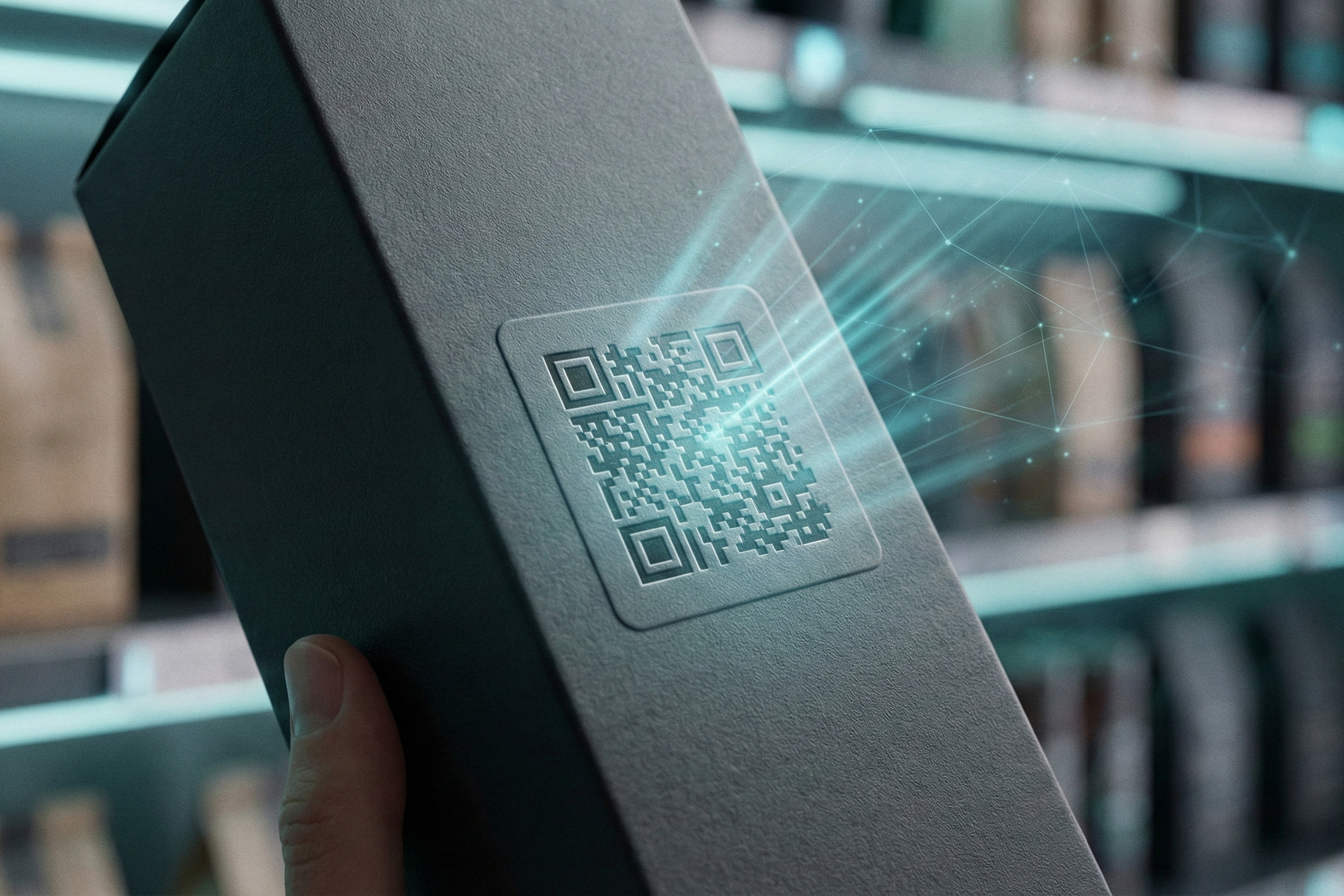
GS1 Digital Link is a global standard that turns a product's barcode into a web address, so scanning it with any smartphone connects directly to online product information, while still working as a traditional barcode at checkout. Think of it as giving every product its own website address, embedded right in its barcode. With the GS1 Sunrise 2027 deadline approaching, businesses that sell physical products need to understand this standard now.
GS1 Digital Link was developed by GS1, the same international standards body behind the UPC barcodes you see on virtually every product in stores. Unlike proprietary QR code solutions, GS1 Digital Link is an open standard that any business can adopt and any technology provider can support. It does three things simultaneously: works as a regular barcode at checkout, opens a webpage when scanned by a smartphone, and acts as a structured data endpoint for supply chain systems.
In this guide, we break down how GS1 Digital Link works, why the 2027 deadline matters, and how to create GS1-compliant QR codes for your products step by step.
GS1 Digital Link vs. Traditional Barcodes: What's Different?
Before diving into the technical details, it helps to understand what makes GS1 Digital Link different from the barcodes you already use. The short answer: traditional barcodes store a number, while GS1 Digital Link stores a web address that contains the same number.
A standard UPC or EAN barcode encodes a GTIN (Global Trade Item Number), which is essentially a product's unique ID. When a cashier scans it, the point-of-sale system looks up that number in its database to find the price. That's all a traditional barcode can do.
A GS1 Digital Link QR code encodes a URL like `https://example.com/01/09501101420014`. That URL contains the same GTIN (09501101420014), so checkout scanners can still extract it. But when a consumer scans it with their smartphone camera, it opens a web page with product details, nutritional information, promotional offers, or whatever the brand wants to share.
Feature: Data format | Traditional Barcode (UPC/EAN): Number only (GTIN) | GS1 Digital Link QR Code: Web URL containing GTIN
Feature: Smartphone scannable | Traditional Barcode (UPC/EAN): No (requires special scanner) | GS1 Digital Link QR Code: Yes (any camera app)
Feature: Web-connected | Traditional Barcode (UPC/EAN): No | GS1 Digital Link QR Code: Yes (opens product page)
Feature: Dynamic content | Traditional Barcode (UPC/EAN): No (static number) | GS1 Digital Link QR Code: Yes (destination can change)
Feature: Multiple identifiers | Traditional Barcode (UPC/EAN): One (GTIN only) | GS1 Digital Link QR Code: Many (batch, serial, expiry)
Feature: POS checkout compatible | Traditional Barcode (UPC/EAN): Yes | GS1 Digital Link QR Code: Yes (backward compatible)
Feature: Future-proof for 2027 | Traditional Barcode (UPC/EAN): Being phased out as sole format | GS1 Digital Link QR Code: Required by Sunrise 2027
What about alternatives? Some companies use proprietary QR code solutions that link to product pages, but these lack the standardized structure that supply chain systems need. GS1 Digital Link's advantage is that it works across the entire ecosystem, from checkout scanners to consumer smartphones to logistics software, because every participant follows the same URL structure.
How GS1 Digital Link QR Codes Work
A GS1 Digital Link QR code encodes a URL that follows a specific structure defined by the GS1 standard. Here is how the URL breaks down:
`https://example.com/01/09501101420014`
In this example, `01` is the GS1 Application Identifier for GTIN, and `09501101420014` is the actual product number. The domain (`example.com`) belongs to the brand or their Digital Link resolver provider.
You can add more data to the URL. For instance, batch and lot information gets appended with `/10/`:
`https://example.com/01/09501101420014/10/ABC123`
Serial numbers use `/21/`, and expiry dates can be added as query parameters like `?17=261231` (December 31, 2026). This means a single QR code can carry the product ID, batch number, serial number, and expiry date all at once.
What happens when someone scans it depends on who is scanning:
At a retail checkout, the POS scanner extracts the GTIN from the URL and processes it the same way it would a traditional barcode. The cashier and customer notice no difference. Behind the scenes, however, the system can also read the batch and expiry data if the retailer's software supports it.
When a consumer scans the QR code with their smartphone, the URL opens in their browser. A GS1 Digital Link resolver (explained in detail below) then redirects the user to the appropriate destination: a product information page, nutritional data, promotional landing page, or recall notice, depending on what the brand has configured.
For supply chain partners, the same URL can be queried programmatically to retrieve structured data about the product, including traceability information, authentication status, and logistics details.
The GS1 Sunrise 2027 Deadline: Why This Matters Now
GS1 Sunrise 2027 is a global initiative that requires retail point-of-sale systems to accept 2D barcodes (QR codes and DataMatrix) alongside traditional 1D barcodes by the end of 2027. This is not a suggestion or a future concept; it is a coordinated deadline backed by major retailers worldwide.
Several major retailers are already testing or have implemented 2D barcode scanning at checkout. Walmart began piloting GS1 Digital Link QR codes on select product categories in 2024. Kroger, Carrefour, and other global chains have announced similar initiatives. The goal is a smooth transition where 2D codes work alongside (and eventually replace) traditional 1D barcodes.
What this means for brands and manufacturers: You will need GS1 Digital Link-enabled QR codes on your product packaging. Packaging redesign cycles typically take 12 to 18 months, which means planning needs to start now if you want to be ready before the deadline.
What this means for retailers: POS systems need to be updated to scan and process 2D codes. This includes updating scanner hardware (most modern scanners already support 2D), updating POS software to parse GS1 Digital Link URLs, and training staff on the new codes.
The bottom line is that the shift from 1D to 2D barcodes is happening with or without any individual company's participation. Brands that adopt early gain consumer engagement benefits immediately, while those that wait risk scrambling to meet compliance timelines.
Key Benefits of GS1 Digital Link for Businesses
Adopting GS1 Digital Link goes beyond simply meeting a compliance deadline. Here are the tangible business advantages:
Consumer engagement. A single scan gives customers product information, recipes, videos, loyalty program enrollment, promotional offers, and more. Unlike a printed label with limited space, a Digital Link can connect to unlimited digital content that you can update at any time without changing the packaging.
Supply chain visibility. With batch-level and serial-level tracking embedded directly in the barcode, businesses gain precise visibility into product movement. You can track which batches went to which retailers, monitor shelf life in real time, and manage inventory more efficiently.
Anti-counterfeiting. Serialized GS1 Digital Link codes enable authentication at the individual item level. Each product gets a unique identifier that can be verified by scanning, making it much harder for counterfeiters to replicate your products.
Regulatory compliance. Beyond Sunrise 2027, GS1 Digital Link positions your products for upcoming regulations like the EU Digital Product Passport (covered in detail below). Meeting these standards proactively avoids costly last-minute compliance efforts.
Operational efficiency. One barcode replaces multiple: the UPC for checkout, a QR code for consumer engagement, and a DataMatrix for logistics. Instead of managing three separate codes on your packaging, a single GS1 Digital Link QR code serves all three purposes.
Marketing analytics. Every scan can be tracked. You get data on geographic engagement, scan frequency, time of day, and which content consumers interact with. This turns your product packaging into a measurable marketing channel.
GS1 Digital Link Use Cases by Industry
GS1 Digital Link applies across virtually every industry that sells physical products. Here is how different sectors are using it:
Retail and CPG. Brands use Digital Link to provide product information, nutritional data, and promotional offers directly from the package. Loyalty programs can be triggered by a scan, eliminating the need for separate loyalty cards. Sunrise 2027 compliance ensures seamless checkout across all retail partners.
Food and beverage. Farm-to-fork traceability becomes practical when every product carries a serialized Digital Link. Consumers can scan to see allergen information, ingredient sourcing details, and recipe suggestions. In the event of a recall, brands can identify affected batches down to the individual package level.
Pharmaceuticals. Serialization for anti-counterfeiting is already a regulatory requirement in many markets. GS1 Digital Link adds a consumer-facing layer: patients can scan medication packaging to verify authenticity, read dosage instructions, and check for recalls or safety updates.
Fashion and apparel. With the EU Digital Product Passport requirements approaching (starting with textiles), fashion brands need a standardized way to share sustainability credentials, material composition, and care instructions digitally. GS1 Digital Link provides the infrastructure.
Electronics. Consumer electronics manufacturers can link products to warranty registration, user manuals, firmware updates, and troubleshooting guides through a single QR code, all without printing a multi-language booklet.
How to Create a GS1 Digital Link QR Code
Creating a GS1 Digital Link QR code involves several steps. Here is the process from start to finish:
Prerequisites: You need a GS1 membership (approximately $250 to $500 per year for small businesses, which includes GTIN allocation), at least one GTIN assigned to your product, and a domain for your Digital Link URLs. The process from GS1 membership approval to your first live QR code typically takes one to two weeks.
Step 1: Get your GTIN. If you do not already have a GS1 membership, join through your local GS1 Member Organization (gs1us.org for US-based businesses). Once approved, allocate GTINs to your products through the GS1 registry.
Step 2: Structure your Digital Link URL. Follow the standard formula: `https://[your-domain]/01/[GTIN-14]`. For example, if your domain is `id.yourbrand.com` and your GTIN is `09501101420014`, the URL would be `https://id.yourbrand.com/01/09501101420014`.
Step 3: Choose a Digital Link resolver provider. A resolver is the service that decides where to send consumers when they scan the code (more on this in the next section). Options include GS1's official resolver, third-party providers, or self-hosted solutions. Importantly, resolvers are not proprietary; you can switch providers without changing your QR codes.
Step 4: Configure your resolver rules. Define what content appears when the QR code is scanned. You can set different destinations based on context: a product page for consumers, nutritional data for health apps, and batch data for supply chain systems.
Step 5: Generate the QR code. Use a GS1-compliant QR code generator to create the physical QR code from your Digital Link URL. Make sure the generator supports encoding the full GS1 Digital Link URI structure.
Step 6: Test scanning. Verify that the QR code works in three scenarios: (a) a smartphone camera app correctly opens the product page, (b) a retail POS scanner correctly extracts the GTIN, and (c) any additional data (batch, serial) is transmitted correctly.
Step 7: Apply to packaging. Place the QR code on your product packaging following minimum size guidelines (at least 15mm by 15mm for reliable scanning). Consider placement that is visible to consumers but does not interfere with existing barcode scanning workflows.
What Is a GS1 Digital Link Resolver?
A GS1 Digital Link resolver is the "traffic controller" that decides where to send a user when they scan a Digital Link QR code. Think of it like a smart redirect service: one QR code can point to different content depending on who is scanning and what they are looking for.
The resolver works through a concept called "linkTypes." When a consumer scans a Digital Link, the resolver checks the request context and redirects accordingly. The same product URL might serve a product information page to a smartphone browser, return JSON data to a supply chain API, or point to a recall notice if one has been issued.
GS1 maintains an official resolver at `id.gs1.org`, and several third-party providers offer resolver services with additional features like analytics, A/B testing of landing pages, and geographic routing. You can also build your own resolver if you have the technical resources.
Regarding cost and vendor lock-in: Resolver pricing models vary. Some providers offer free tiers for small product catalogs, while enterprise solutions charge per scan or a flat monthly fee. The key point is that because GS1 Digital Link is an open standard, your Digital Link URLs are yours. If you want to switch resolver providers, you update your DNS settings; the QR codes on your products do not need to change.
EU Digital Product Passport: How GS1 Digital Link Fits In
The European Union is rolling out Digital Product Passport (DPP) regulations that require products sold in the EU to carry machine-readable digital identifiers linked to sustainability, composition, and lifecycle data. The first category affected is batteries (starting February 2027), with textiles, electronics, and other categories following in subsequent phases.
GS1 Digital Link is emerging as the preferred infrastructure for DPP compliance because it already provides the standardized, web-accessible identifier structure that the regulation requires. Rather than building a separate DPP system, companies that have adopted GS1 Digital Link can extend their existing product identifiers to include the required sustainability data.
This matters for US-based businesses too. If you sell into the EU market (or plan to), preparing for DPP now avoids expensive retroactive compliance. And while the US does not currently have equivalent legislation, industry observers expect similar regulations to follow. Canada, the UK, and several Asian markets are watching the EU's implementation closely.
The connection between Sunrise 2027 and the EU DPP creates a compelling case for action: businesses that adopt GS1 Digital Link for Sunrise 2027 compliance are automatically positioned to meet DPP requirements with minimal additional effort.
Getting Started: Your GS1 Digital Link Implementation Checklist
Ready to get started? Here is a practical checklist to guide your implementation:
- Confirm GS1 membership status. If you do not have a membership, join at gs1us.org (US) or your local GS1 Member Organization.
- Assign GTINs to all products that need Digital Link. Make sure every product in your catalog has a registered GTIN.
- Choose a Digital Link resolver provider. Evaluate options based on your product catalog size, analytics needs, and budget. Start with a provider that offers a free tier if you want to test before committing.
- Define content destinations for each product. Map out what information each product scan should deliver: product page, nutritional info, user manual, warranty registration, etc.
- Select a GS1-compliant QR code generator. Use a tool like UseQRKit's QR code generator that supports the full Digital Link URL structure.
- Design packaging with QR code placement. Follow minimum size guidelines (15mm by 15mm minimum) and choose a placement that is visible to consumers.
- Configure resolver rules for different scan contexts. Set up smartphone vs. POS scanning responses, and configure any conditional content (geographic routing, language variants).
- Test scanning across devices and scenarios. Test with at least three different smartphones, one POS scanner, and verify that batch/serial data transmits correctly.
- Set up scan analytics tracking. Configure your resolver or analytics platform to track QR code scans so you can measure engagement from day one.
- Plan your rollout timeline aligned with Sunrise 2027. Start with a pilot product or product line, then expand to your full catalog.
FAQ
What is GS1 Digital Link?
GS1 Digital Link is an open standard developed by GS1 that embeds a web URL into a product's barcode. This allows the barcode to function both as a traditional product identifier at checkout and as a gateway to online product information when scanned by a smartphone. It works with QR codes and DataMatrix formats.
What is a GS1 Digital Link QR code?
A GS1 Digital Link QR code is a QR code that encodes a standardized URL following the GS1 Digital Link format. Unlike a regular QR code that can link to any URL, a GS1 Digital Link QR code contains structured product identifiers (like the GTIN) within the URL, making it compatible with retail checkout systems and supply chain data requirements.
What is the GS1 Sunrise 2027 initiative?
GS1 Sunrise 2027 is a global initiative requiring retail point-of-sale systems to accept 2D barcodes (QR codes and DataMatrix) in addition to traditional 1D barcodes by the end of 2027. Major retailers including Walmart and Kroger are already piloting 2D barcode scanning. The initiative is driving widespread adoption of GS1 Digital Link as the standard for next-generation product barcodes.
How do I create a GS1 Digital Link QR code?
To create a GS1 Digital Link QR code, you need a GS1 membership and at least one GTIN. Structure your URL using the format `https://[domain]/01/[GTIN]`, set up a resolver to direct scans, then generate the QR code using a GS1-compliant QR code generator. See the step-by-step guide above for the full process.
What is a GS1 Digital Link resolver?
A resolver is a web service that receives GS1 Digital Link requests and redirects them to the appropriate destination. When a consumer scans a product's QR code, the resolver determines where to send them based on context (product page, nutritional data, recall notice, etc.). GS1 offers an official resolver at id.gs1.org, and third-party providers offer additional features.
Do I need a GS1 membership to use Digital Link?
Yes. GS1 Digital Link requires valid GTINs, which are only available through GS1 membership. For US businesses, membership through GS1 US starts at approximately $250 per year for small companies. The membership includes GTIN allocation, access to GS1 standards documentation, and eligibility for the GS1 Company Prefix needed to issue your own GTINs.
What is a digital link GS1 2D barcode?
A GS1 2D barcode is a two-dimensional barcode (QR code or DataMatrix) that carries GS1 standardized data. When that 2D barcode encodes a GS1 Digital Link URL, it becomes a "digital link GS1 2D barcode," meaning it combines the physical scanning capability of a 2D code with the web-connected functionality of the Digital Link standard. This is the format being adopted under the Sunrise 2027 initiative.
Is there a free GS1 Digital Link QR code generator?
You can generate GS1 Digital Link QR codes for free using tools like UseQRKit. However, you still need a GS1 membership (which has an annual fee) to obtain the GTINs required for valid Digital Link URLs. The QR code generation itself can be free, but the underlying product identifiers require GS1 registration.
What is the difference between GS1 Digital Link and a regular QR code?
A regular QR code can encode any URL or text, with no standardized structure. A GS1 Digital Link QR code encodes a URL that follows a specific format containing standardized product identifiers (GTIN, batch, serial). This structure means GS1 Digital Link codes work at retail checkout, can be read by supply chain systems, and still open consumer-facing web pages, whereas a regular QR code is only useful for the single purpose it was created for.
Are there alternatives to GS1 Digital Link?
Alternatives include proprietary QR code platforms (like custom-branded QR solutions), other 2D barcode standards (like HIBC for healthcare), and simple URL-based QR codes without standardized structure. However, GS1 Digital Link is the only standard that provides backward compatibility with retail POS systems, interoperability across the global supply chain, and compliance with emerging regulations like the EU Digital Product Passport. For businesses selling physical products through retail channels, GS1 Digital Link is the recommended path forward.


